





by Douglas Clark
Oil spills and man made pollutants leap to mind at the mention of endangered sea life and toppled ecosystems, but unknown to most laypeople, an everyday event in the world of maritime transport is actually among the most significant threats to marine ecology today. Without any of the widespread attention given to a toxic spill, cargo ships and other vessels move from port to port around the world and often quietly introduce non-indigenous species that can wreak havoc in their new habitats. Wesley Wilson, an engineer with the Computational Fluid Dynamics group at the Naval Surface Warfare Center, Carderock Division, in Bethesda, MD, and his colleagues are conducting research that may one day help ocean freighters and other ships to dramatically curb the spread of non-indigenous species.
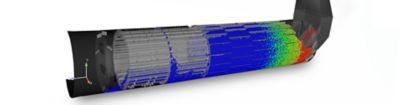
This animation shows salt-water volume fraction contours on several planes during a ballast water exchange simulation in a full-scale tank.
The time steps between the animation frames increases during the later portions of the animation.
Initial fresh water in the tank is shown in red, while incoming salt water is in blue.
Read more...