



|
“This article appeared in ANSYS Solutions Volume 7 Issue 3. For more information on ANSYS software, visit www.ansys.com.”
CEI’s EnSight software brings new levels of animation, realism and
detailed display of simulation results to the desktops of engineers and
analysts.
By Bob Cramblitt
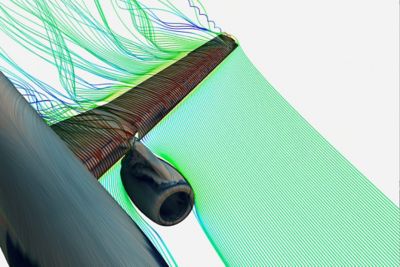
NASA used it to provide insight into complex flow physics for
Discovery’s redesigned external fuel tank, to interpret flight and
wind-tunnel data, and to design tests with smaller-scale models.
CRAFT Tech® uses it to study terabyte-sized fluid dynamic and
combustive problems associated with weapons delivery systems for
supersonic fighter jets.
Researchers at the National Energy Technology Laboratory and Pittsburgh
Supercomputing Center use it to better understand complex hydrodynamics
that can lead to safer and more energy-efficient pulp and paper
manufacturing.
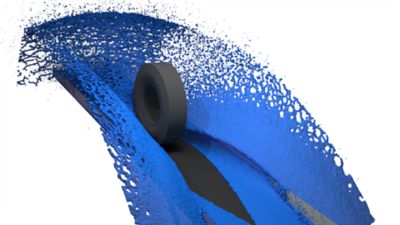
Embraer uses it to drive fully immersive virtual reality (VR) for engineering analysis, simulation and virtual testing.
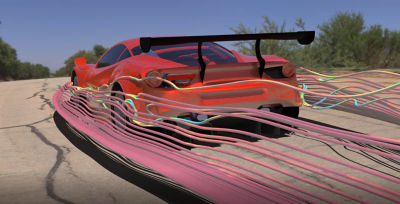
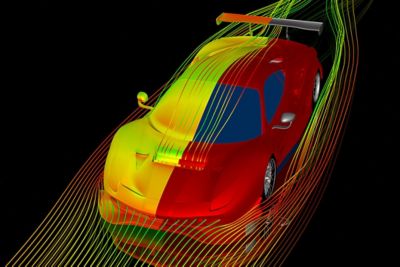
And DaimlerChrysler used it to help fuel its triumphant return to NASCAR’s Nextel stock car circuit after a 25-year absence.
It’s extreme visualization, and, thanks to a combination of greater
computing power at lower costs, major software advances, compatibility
with major CAE solvers and ability to run on a variety of computing
platforms, the technology is revolutionizing the way engineers and
scientists see, analyze, communicate and interact with their
computational results.
The Democratization of Visualization
Over the last 10 years, a remarkable transformation has occurred in
high-end visualization: Capabilities that once were available only to a
select few now are accessible to almost anyone on any platform for any
simulation application.
Animated visualizations can be generated for CFD, FEA, crash analysis
or even coupled simulations combining results from different vendors’
simulation programs. Displays can range from a standard color screen to
stereo using low-cost glasses to immersive virtual reality devices such
as PowerWallTM and CAVEs.
Computing can be done on anything — from a laptop equipped with a
decent graphics card to a desktop PC of any flavor (Windows, Linux or
Mac OS X), to a high-end workstation cluster with dozens of nodes or
high-capacity shared-memory processors.
The power of visualization is no longer limited to analysts or
visualization specialists. Free software such as EnLiten from
Computation Engineering International (CEI) enables scientists and
engineers to share their work with colleagues to create a greater
understanding of problems and solutions.
A Quiet Revolution
The revolution in visualization did not announce itself with fanfare
like the dot.com boom, and it didn’t suffer from the bloated
expectations that made the dot.com bubble burst. Instead, it occurred
through steady building over the years, and the peak isn’t anywhere in
sight. Advances in visualization and growing user benefits are making
strong progress year by year.
“People are awakening to the power of visualization,” says Kent
Misegades, CEI president, “and with that awakening come new
applications, new customers and greater penetration into the mainstream
of large engineering, research and scientific organizations.”
As the technological and market leader in extreme visualization, CEI
serves as a good benchmark for progress in this field. Here are just
some of the milestones that have been achieved over the last six years:
- Los Alamos National Laboratories and CEI break the
1-billion-cell barrier for visualization in 1999 and reach 11.5 billion
cells a year later. Eyes are now on 100 billion cells, inconceivable a
decade ago.
- Free tools such as EnLiten enable complex 3-D
models and animations to be viewed and manipulated by anyone within the
enterprise — even novices who don’t have any visualization application
on their desktops.
- CEI’s EnSight becomes available on 64-bit
computers, enabling more complex visualizations with multivariate data
to be cached on desktop systems.
- Extreme visualization comes to the AppleTM Mac OS
X, enabling animations generated on high-end servers to be shared with
Mac users at home or on the road. CEI now provides interchangeable
visualization tools for every computing platform and operating system.
- A parallel rendering compositor developed by CEI
achieves a world-record rendering speed of 3.17 billion polygons per
second on a cluster of 76 standard PCs.
- CEI folds its record-breaking distributed rendering
technology into a product called EnSight DR, the first commercial
visualization application to bring parallel graphics to the user’s
desktop.
- New features such as ray tracing and multiple
lighting sources increase image realism, making it easier to
communicate complex concepts to non-technical audiences.
Complementary Technologies
High-end visualization on EnSight is easily accessible to ANSYS users
through freely available interfaces provided by CEI. As a result, the
strength of ANSYS simulation technology is complemented by the
capabilities of EnSight.
“ANSYS products and EnSight scale very well on huge problems that are
typical of the markets we serve,” says Marcus Reis of Engineering
Simulation and Scientific Software (ESSS), a leading distributor of
ANSYS and CEI software that provides simulation and visualization
solutions for companies such as General Motors, Petrobras, Embraer,
Embraco (Whirlpool), Electrolux and others. “Our customers have very
demanding applications that require them to be able to quickly and
easily visualize multiple results files with extensive transient
analysis from ANSYS CFX and other software.”
A recent project initiated by Silicon Graphics Inc. (SGI), CEI, ESSS
and Matthew Koebbe, a consultant with GADAB Engineering, shows how
extreme visualization can be used to understand fluid flows that cannot
be accurately predicted by other testing methods.
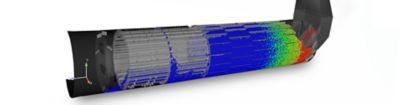
Vectors of Axial Velocity + Mesh Details, image courtesy of ESSS.
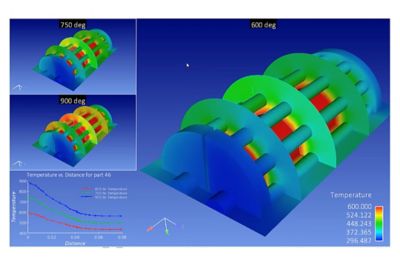
Streamlines colored by velocity magnitude, image courtesy of ESSS.
Embraco of Brazil, a supplier of compressors and other products for
Whirlpool, wants to better understand the flow within the suction
muffler of a small hermetic refrigerating compressor used in household
appliances. The challenge undertaken by Embraco researchers Fabian
Fagotti and Celso Kenzo Takemori is to capture pressure fluctuations,
such as noise, over a broad range of frequencies. Although this might
sound relatively simple, just simulating internal pressures up to 10
MHz at various points could require a mesh of nearly 5 million nodes
and 80,000 time steps.
ESSS is starting with a more coarse mesh and refining the model to see
how far state-of-the-art computer technology can go in addressing
Embraco’s problem. ANSYS CFX was chosen as the solver because of its
reputation for resolving fine-scale turbulent behavior. EnSight was
selected as the visualization tool for a number of reasons, including
its handling of complex and transient simulations, ability to read in
results of multiple simulation cases for direct comparison and support
of a scripting language for batch processing. SGI PrismTM hardware was
used for the initial computing work.
Early results for the project are promising. Simulations showed
pressure behaving as expected based on real-world use, and phenomena
that couldn’t be determined by experiments have been simulated in the
computational realm. Quantified estimates of leakage, for example, have
been determined by analysis of mass flows. Color-coded pathlines
generated by EnSight are providing a better understanding of mixing
within the compressor.
ESSS currently is working with Embraco to determine future directions
for the project, although the initial stage already has fulfilled a
major benefit of extreme visualization: enabling customers to see what
they couldn’t see before.
From Extreme to Pervasive
Although tremendous progress has been made in visualizing complex
problems, in some ways the most exciting developments are still to
come. Capabilities such as parallel processing, distributed rendering,
photorealistic imaging and highly sophisticated animations not only are
making their way to the desktop, but are being implemented so the
complexities are hidden from the user. There will be more going on than
ever before behind the nice, simple-to-use graphical user interface
(GUI) — but the user will be blissfully unaware of it.
Some of the things that CEI is working on include greater parallel
processing automation, GUI customization that speeds access to commonly
used functionality, 2-D texture maps that increase image realism,
lower-cost software for small shops and consultancies, and greater
flexibility in compiling and editing animated videos.
“What we call ‘extreme visualization’ today will be commonplace,
transparent and pervasive in the near future,” says Misegades. “We are
automating the process to such an extent that ‘post-processing’ will be
an extinct phrase — any engineer, scientist or researcher will be able
to take results from practically any solver and easily turn out
beautiful and revealing 3-D animations with little effort and few
specialized skills.”
Web sites with more information
- Computational Engineering International (CEI), www.ensight.com
- Engineering Simulation and Scientific Software (ESSS), www.esss.com.br
- Silicon Graphics Inc. (SGI), ww.sgi.com
- ANSYS Solutions, www.ansys.com
|