



EnSight Helps Reduce Wind Noise in General Motors Vehicles
By Douglas Clark
When dark storm clouds suddenly unleash a beating rain, there’s a real feeling of relief for any driver as the wipers take their first swipe across the windshield, instantly bringing the road back into view. But as real as this relief may be in rainy weather, it’s easy to forget about wipers once the sun comes out—or at least that’s the case if you’re driving a General Motors car or truck. That’s because engineers at General Motors are using Computational Fluid Dynamics (CFD) to reduce the whooshing and whistling sound of wind noise that wipers create, keeping these foul-weather friends out of mind until the next rainfall.
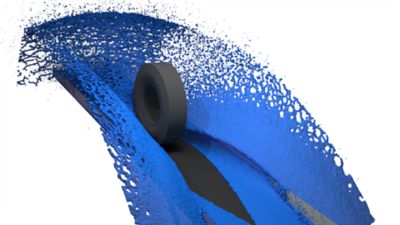
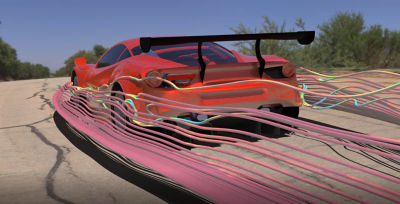
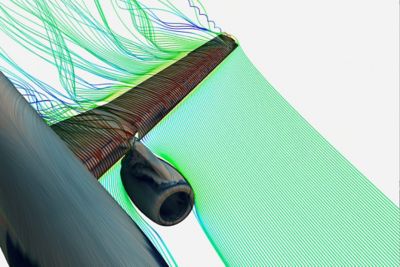
This EnSight animation simulates wind-tunnel
airflow around the wipers and is ultimately used in the calculation of
resulting wind noise.
Why wipers are such a challenge
It might seem that a small automotive part like wipers shouldn’t
command so much attention from engineers, but today’s automotive
manufacturers are giving wipers more attention than ever. Wipers are
essentially the victims of a variety of engineering successes that have
reduced noise from other areas of the car, suddenly leaving wipers
seeming rather noisy.
“Because tire and engine noise has been reduced with various kinds of
new technology, wind noise becomes a greater overall contributor to
what can be heard inside the automobile,” says Ken Karbon, a staff
engineer at General Motors who specializes in aerodynamics, “and wipers
are potentially a significant source of wind noise.”
When you consider that wind noise consistently ranks highly among
drivers’ concerns in consumer surveys, wipers are suddenly no small
matter. Furthermore, where there’s noise, there’s generally aerodynamic
drag, which auto manufacturers seek to minimize for improved fuel
efficiency.
The most obvious way to eliminate wiper wind noise would be tucking
idle wipers out of sight—and thus out of the airflow—as was done on
many cars years ago. This idea, however, often runs head-on into
engineering difficulties and aesthetic issues. First, as automobiles
have become more compact, there’s less room under the hood to stow
anything that doesn’t have to be there, including wipers, the wiper
motor, and any necessary linkages. Second, the moment wipers emerged
from beneath the hood’s edge to sit in their idle position on the
windshield, they immediately gained the status of styling elements.
Now, stylists skillfully use wipers and hood features to add character
to automobiles, making them more attractive to potential buyers.
Balancing style with performance
When concerns of styling and engineering overlap, traditionally a small
game of tug-of-war develops. Stylists are constantly striving for a new
and innovative look, while engineers are chiefly focused on
performance, which puts the two design teams at odds by their very
nature. After all, the best looking car is generally not the most
aerodynamic, and vice versa, so compromises have to be made to achieve
the fine balance that creates a winning design.
Cross-section of the aerodynamic model showing velocity vectors around the wipers.
Traditionally, one of the important tests that helped determine
whether the right balance had been struck was the wind tunnel. This
testing compared a vehicle’s noise-level and aerodynamics with the
company’s accepted standards.
In the past, there was a lot on the line during wind tunnel testing.
One of the major reasons for this was that at any auto manufacturer,
acoustic vehicle prototypes aren’t generally ready until fairly late in
the design process. With little time left, any surprises in the wind
tunnel could jeopardize the entire production schedule. This situation
left little room for error, and fewer options to fix wind-noise
problems when they arose.
“By traditional methods, there was some minor tweaking we could do
around the wipers, but in some cases we had no choice but to make
changes that weren’t ideal, like using thicker windshield glass—which
adds mass—to prevent the transmission of the noise to the inside of the
car, rather than tackling the source of the noise,” notes Karbon. “Per
federal safety standards, cleaning performance must also be preserved
with any change to the wiper system.”
The added cost—as well as the frustration—of having to sometimes make
these kinds of late changes prompted Ken Karbon to develop a new
process to optimize wiper design early in the schedule.
Virtual simulations streamline the process
Engineers are now able to greatly reduce the element of surprise in
wind tunnel testing, thanks to virtual airflow simulations. As a matter
of routine, an aerodynamics CFD model is made by GM analysts for every
new car design. Ken Karbon decided to take advantage of this existing
work and now uses these CFD models in a new process that ensures that
windshield wipers won’t affect a vehicle’s timely completion.
Karbon further analyzes the proposed wiper geometry with the CFD
model. When the data is viewed in EnSight, a visualization software
program from Computational Engineering International (CEI) in Apex, NC,
the resulting graphics make it clear whether the proposed design will
meet wind noise standards. And when it’s obvious that improvements are
needed, the graphics clearly show where improvements can be made.
“Now it’s a matter of hours to check the wind noise created by the
wipers. And these wiper results are practically free since we utilize
existing aerodynamics models,” points out Karbon. “Using one CFD
simulation to produce a variety of useful results shows the power of
computer-aided engineering.”
Thanks to the new method, just a couple of hours of work give GM
valuable wind-noise data six to eight months before the new vehicle
prototype ever arrives in the wind tunnel. In other words, the team has
the luxury of these months to fine-tune and adjust designs to reduce
wiper wind noise to acceptable levels.
One of the reasons the process has also been so effective is because
EnSight has made it incredibly easy to explain and share results with
engineering colleagues, or with automotive stylists and other
non-technical members of the team.
“The visual results have been a very effective communications
tool—particularly with wiper designers. Graphics that show why the
noise requirements are being violated tell the whole story. It’s no
longer just an engineer’s opinion,” explains Karbon.
In addition, because EnSight allows changes to be made on the fly,
engineers can test various wiper positions and configurations, and then
supply designers with specific boundaries to work within, such as a
particular zone on the windshield where wipers can rest while idle.
These guidelines allow room for creativity, while still meeting
wind-noise standards.
“None of the techniques I’ve developed are possible with our other CFD
tools. The post-processing features of EnSight are just so much more
powerful than any other software we use. It lets us create detailed
images and manipulate the data in a way that really fits our approach.”
General Motors is now to some extent a model in this particular area of
computer-assisted engineering. Not only has the company implemented
effective measures for reducing wiper wind noise, but it has also
created a better design environment. It has successfully reduced the
industry’s traditional “drag” and “friction” between styling and
engineering colleagues, which means better teamwork. The company is now
looking at other areas, such as the designing of side rear-view
mirrors, to continue building on its success with CFD and EnSight
visualizations.
More Information
Windshield wiper primer
Windshield wipers seem like a matter of common sense, but the world went without them until Mary Anderson watched a New York City streetcar driver reach out the window to clean his windshield. Read more about the history of the wiper here: http://inventors.about.com/library/inventors/blanderson.htm
Hold on to your hat
Wind tunnels are used to evaluate the aerodynamics of many things, such as aircraft and automobiles, and there are several types of tunnels of varying sophistication and purpose: http://en.wikipedia.org/wiki/Wind_tunnel