




|
The EnSight visualization environment for 32-bit and mobile users.
The power of Lite includes:
- Interfaces to all major CAE solvers including FEA, CFD,
structures, crash, dynamics and hydrocodes through dozens of data
readers.
Command language able to run scripts, macros and batch operation.
- Computes new variables with a vast number of calculator functions.
- Interfaces with freely available EnVideo and EnLiten to allow easy sharing of images, animations, and geometry.
- Handles natively a wide range of data types to maximize use with the widest range of data possible:
- Structured, unstructured, and mixed 1D, 2D, and 3D linear and quadratic elements as well as n-sided 2D and n-faced 3D.
- Constants, scalars, vectors, tensors, complex scalars, and complex vectors.
- Vertex-based and element-based variables.
- Steady-state as well as transient with full connectivity changes such as failed elements or adaptive meshing.
- Able to activate parts and variables on an as-needed basis.
- Reads and writes in a documented and “open” native file
format. Your data will not become trapped in a proprietary file
format.
- Comprehensive, industry-leading documentation.
- Runs on 32-bit Windows, Linux and Apple.
- Easy to use and learn.
Need more clarification on which visualization product is right for you? Click here for our project comparison chart.
More Information
EnSight Lite wins the
2006 HPCWire Readers' Choice Award for Best Price/Performance for HPC
Visualization Product or Technology, for more information click here.
A simple tutorial on how to use EnSight
This tutorial provides a step-by-step demonstration of basic EnSight
operation. After successfully completing this tutorial, you should be
able to start EnSight, read a dataset and load a model, transform
objects in the Graphics Window, reset transformation, work with parts
and change part attributes, save an image to a file, and exit EnSight.
A simple tutorial on how to use EnSight, specifically for CFD
This tutorial provides step-by-step instructions for performing many
basic postprocessing operations – especially those relevant to
computational fluid dynamic analysis. After successfully completing
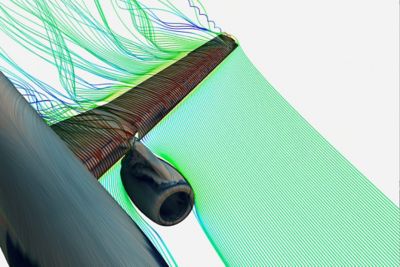
this tutorial you should be able to create a clipping plane and display
contours and vector arrows on the plane, move the clipping plane with
the mouse, create an isosurface and change the isovalue interactively,
create a single particle trace and a rake of traces and save an image
of the Graphics Window to a file.
|