


|
by Bob Cramblitt
Small things often sell cars and create brand loyalty: the positioning
of the cup holder; how the seat molds to your body; the thunk of the
door when it closes. Add to that list how particles – whether
they are rain, snow or dirt – disperse across the surface of a car.
Particle behavior in relation to the surface of a car is known in the
automotive industry as vehicle soiling, and up until recently, it was
nearly impossible to simulate in a computer. But within the last
few years, Audi has made major strides in using CFD simulation and
visualization to better predict the complex interactions that
constitute vehicle soiling.
Audi’s research has been made possible through a confluence of
technological developments, including supercomputing-like power on
low-cost PC clusters, new meshing software, engineering solver code
that can handle two-phase flow models, and visualization software that
enables researchers to see complex surface-particle interaction over
time.
Hidden complexity
It seems simple when you are sitting inside a car: Raindrops fall from
the sky and onto the surface of your car; the drops converge into a
sheet of liquid film, then break up and disperse under the influence of
aerodynamic forces.
|
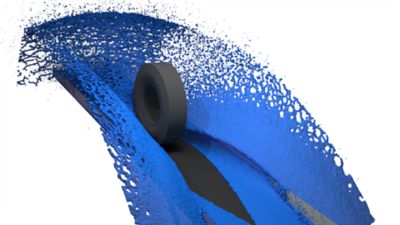
EnSight visualization shows water droplets dispersing from an Audi car.
|
But, there’s more going on than meets the eye, according to Dr. Moni
Islam, who works on vehicle soiling research at Audi’s wind tunnel
center. Dr. Islam says that accurately simulating the effects of
rain on the surface of a car requires taking several major issues into
account, including size and velocity of raindrops, their impact on
solid surfaces, speed of the car, the formation and transport of liquid
film, and how liquid film breaks up when faced with aerodynamic forces.
Additional complex properties to consider include the characteristics
of particles generated from the road surface and the wheels of a moving
car, the geometric details of the vehicle surface, and the unique
interaction between solid particles and a solid surface in the case of
snow and dirt deposition.
Since 2003, Audi has been working with Icon, a CFD services company, to
simulate and visualize these complex factors, and to validate the
results from wind-tunnel and field tests. The research holds the
promise of being able to accurately predict soiling early in the
product development cycle. This would allow Audi to produce
designs that further minimize build-up and improve dispersal of rain,
snow and dirt on a car’s surface, leading to greater driver and
passenger comfort.
From physical to virtual testing
Until recently, vehicle soiling was studied almost exclusively through
wind-tunnel and field testing. Audi tests for side-window soiling
at the RUAG Aerospace wind tunnel in Emmen, Switzerland. In these
tests, a car is sprayed with water containing a fluorescent dye.
The spray is calibrated according to the known properties of natural
rain and the simulated speed of the car. The car is lit with
ultraviolet light to bring out the color of the dye and highlight the
movement of water droplets and film. The entire process is
captured on film and by static pictures.
|
|
|
|
|
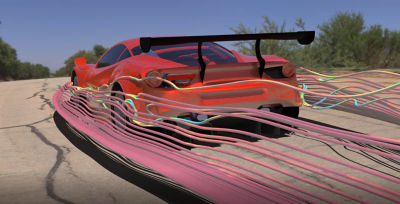
| EnSight visualization showing soil deposition at the rear of an Audi car. |
|
|
|
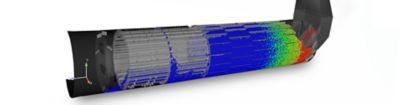
EnSight visualization showing soil deposition on the tires of an Audi car. |
Road testing is performed to determine soiling on the rear of the
vehicle, such as dirt or snow collected on the bumper from the road
surface and tires.
While effective from a qualitative standpoint, wind-tunnel and road
testing are expensive and require physical prototypes. Computer
simulation is unlikely to replace physical testing altogether, but it
can save substantial time and money in the early stages of new vehicle
development. It can also improve quality by allowing engineers to
assess soiling characteristics early on, and tweak their designs for
greater efficiency.
Exploring new techniques
Audi and Icon use a one-way coupling between the gas and liquid/solid
phases to simulate vehicle soiling in a computer. In this
approach, the liquid/solid phase is influenced by the gas phase, but
not vice versa. This reduces computing overhead without
sacrificing computational accuracy, according to Dr. Islam.
The simulations are made possible by two-phase modeling capabilities in
STAR-CD, CD-adapco’s CFD software. STAR-CD offers both two-phase
Lagrangian models – an approach for time-resolved simulation of
discrete particles – and liquid-film models.
Where once processing of the sizable models used by Icon – up to 75
million cells for meshing and 20 million cells for visualization –
would take expensive supercomputers to process, they can now be handled
by low-cost Linux clusters. Icon uses a network of 32 AMD Opteron
CPUs running Suse Linux.
The process begins with a CATIA assembly provided to Icon by
Audi. Models typically contain hundreds of thousands of
components and take up tens of gigabytes of storage space. They
are often imported from CATIA to ANSA preprocessing software for what
is known as “CAD surface preparation” – manipulating the CAD surfaces
to fulfill the requirements of the meshing software.
Automated hex meshing
The model is imported into meshing software that makes it possible for
STAR-CD simulations. In the past, this was the first stumbling
block for realistic simulations of vehicle soiling. The majority
of meshers produce tetrahedral cells, which limit the accuracy and
detail of the mesh. Creating the mesh quality required by Audi
once meant building by hand, according to Simon Weston, general manager
at Icon.
“It would take several weeks for us to hand-build the type of
block-structured meshes we needed,” says Weston. “This limited
the number of tests we could perform in the time we had available.”
Icon was able to overcome this obstacle by implementing hexahedral meshing software called Harpoon from CEI.
“We prefer to use hexahedral cells whenever possible, and we’ve found
Harpoon to be a powerful tool for building predominantly hexahedral
meshes,” says Weston. “Usually, the trade off is that hex meshes
are consuming to create, but Harpoon can create large and complex
meshes in minutes.”
The automated software has enabled Icon to shift much of the time that
used to be taken building meshes into doing more simulation and
analysis work.
“We now have the time to analyze our designs in more detail and
increasingly perform larger and more complex simulations,” says
Weston. “We can perform multiple runs of complex meshes and
thereby save our customers money on engineering development and
testing.”
Modeling real-world behavior
After meshing, models are loaded into STAR-CD, which enables
researchers to test different soiling conditions for a range of vehicle
configurations. Water droplets are modeled according to the
Lagrangian principles, and boundary conditions are set to analyze
different droplet sizes and velocity situations.
A liquid-film model within STAR-CD is linked with a splashing model
that predicts the behavior of droplets hitting a solid surface, such as
the car’s hood, windshield or back bumper. The models simulate
droplets as they bounce, adhere to the surface, or splash; depict how
droplets form the liquid film; and show how the film behaves when
confronted with aerodynamic forces. STAR-CD captures liquid-film
qualities such as temperature, thickness, mass and velocity.
|
Visualization of film thickness over time created with EnSight from STAR-CD results.
|
“The splashing model and liquid-film transport models within STAR-CD
are really what make it possible to simulate these complex
interactions,” says Weston. “Low-cost cluster computing systems
are important as well, since they enable us to easily manage computing
resources without buying supercomputing time.”
Revealing visualizations
While the results from STAR-CD deliver a detailed simulation of vehicle
soiling over time, 3D visualization of transient phenomena that makes
complex data easier to see, analyze and understand must be carried out
in order to derive useful information from the simulations. For
that kind of visualization, Icon exports files directly from pro-STAR,
STAR-CD’s graphical user interface, into CEI’s EnSight software.
EnSight supports all the element types within STAR-CD, as well as
transient data such as moving meshes and particles.
“We can read in everything from STAR-CD into EnSight, and even extract
certain data not otherwise available,” says Francisco Campos, a
consultant and CFD engineer for Icon. “The impact of droplets on
the surface, statistical quantities, droplet size and volumes – all of
this can be brought into EnSight for high-end visualization.”
The major capability that EnSight provides for Icon’s work is
visualization of transient data – animations and interactive objects
that show how selected elements behave over time.
“It’s simple to create the time steps, plug-in quantities such as
temperature and droplet diameter, and then look at the graphical data
any way you want,” says Campos. “And, you can create a script
that can then be applied to similar cases.”
The 3D visualizations enable Icon to see details that would not be visible by other means.
|
|
Visualization created in EnSight from STAR-CD results of water film
forming on the front of an Audi car.
|
“We can look at very small droplets, determine when droplets become
film and how the film drops off the car,” says Campos. “We can
filter out certain data to get a clearer view and isolate droplets from
the liquid film.”
According to Weston, the value of EnSight visualizations extends beyond research.
“It’s a powerful tool for studying the results of our simulations and
communicating them to Audi and within our own organization.”
For further investigation…
Icon’s work with Audi to date has centered on simulations depicting
soiling at the rear, front and side of the car; and film break-up that
causes wing-mirror soiling.
In general, qualitative simulations that realistically depict behavior
and can be verified by wind-tunnel and road tests have been
promising. Further testing is required to collect more detailed
quantitative data and compare it to physical testing results.
Work is also needed to simulate certain conditions seen in wind-tunnel
tests, such as water streaks. Water streaks are highly dependent
on small geometry features and microscopic surface properties, and have
inherently stochastic behavior, both of which are currently not part of
the simulation model.
Audi’s present research is focusing on particle behavior on the
vehicle’s surface. There are external factors that add to this
complex picture, according to Dr. Islam, including unsteady air flow
and turbulence, interaction with other vehicles, and road and tire
surface characteristics.
There is little doubt that accurately predicting vehicle soiling
through computer simulations – and applying this method as a standard
part of the development process – will be a major challenge for years
to come. But, the combination of Audi’s aerodynamics expertise
and dedication, Icon’s expertise in applying CFD and visualization to
the problem, and the ever-quickening pace of technology development
make the road ahead clearly visible.
###
Additional resources
Additional information on Audi, Icon and simulation and extreme
visualization for the automotive industry can be found at:
Audi AG, Wind-Tunnel Centre, 85045 Ingolstadt, Germany
ICON Simulation Services, Rofel House, Colet Gardens, London, W14 9DH, UK
Ford wins ExtremeSim award, click here for more.
Aero Concept Engineering uses CFD visualization to maximize
aerodynamics for LeMans prototype, click here for full story.
GM of Brazil purchases EnSight, gm_vsas.pdf
CFD visualization helps DaimlerChrysler accelerate return to NASCAR fast track, daimlerchrysler.pdf
UMR racing team uses advanced visualization to overturn conventional aerodynamic wisdom, fsae.pdf
Prodrive speeds Ferrari wing development with reverse engineering &
CFD technologies, click here for more.
|